AI and the Future of Bookkeeping: Risks & Opportunities
AI and the Future of Bookkeeping
What Changes, What Doesn't, and Where the Opportunities Are
In December 2022, I shared a post in my coaching group that began: "OMG, I have to share this with you guys!! This is phenomenal. If any of us were in any doubt as to how AI is going to affect our world, check this out."
It's fair to say a lot has happened in the AI world since then!
I've spent a lot of time playing with, testing, and using AI relatively successfully in my own business, and I’ve been talking a LOT to bookkeepers and other experts about what they're seeing. We've talked about the tools they're using, what they're worried about, what's happening with their clients and what they think it all means for the future of our industry.
Through those conversations, I've developed quite a few thoughts of my own.
Most of what I'm hearing is exciting. Still, some of it is concerning, and some of it is challenging assumptions we’ve held as an industry for a long time about the work bookkeepers do, the value we provide, and what that value will look like or morph into in the future.
I recently wrote about what AI might mean for bookkeeping pricing, because that’s as good a place as any to start, especially on the back of my recent free masterclass, Pricing for Profit: Beyond the Hourly vs Value-Based Conversation.
But the conversation is much broader than pricing alone. In this article I start to look at what AI might replace, what it might not, where the opportunities are for bookkeepers and what we should be doing now.
I don't believe that anyone can tell us with certainty what bookkeeping will look like in five or ten years. Technology is moving way too quickly for that. But we can look at what's happening now, consider what it means for our businesses and our clients, and make some sensible decisions about how we respond.
I think that's a much better conversation to have now, rather than simply asking whether AI will replace bookkeepers.
Although that is where a lot of people start anyway, so I may as well start there too.
What's changing in bookkeeping
Will AI replace bookkeepers?
At one end of the conversation are some people predicting that AI will replace bookkeepers altogether. At the other end, there are people reassuring bookkeepers that AI will never replace them because clients will always want a human.
I lean towards the second view, but it's not that simple.
It seems indisputable that AI will replace some of the work bookkeepers currently do. We’re already seeing that with many tasks that used to be a lot more time-consuming and complex.
Think transaction coding, account reconciliations, data extraction, report analysis and identifying unusual transactions. These are all areas where technology has been reducing manual work for years, and AI has the potential to take that a lot further. We shouldn't pretend otherwise.
But there's an important distinction between replacing some of the work a bookkeeper does and replacing the bookkeeper. Whether one leads to the other depends, at least in part, on what work we're doing, who we're doing it for and what our clients actually want from us.
I still believe there's a lot of opportunity for bookkeepers in an AI world, but what that means for individual bookkeepers remains to be seen.
We've been through technological change before
When I started my bookkeeping business, the world looked very different. We were working with desktop accounting software and either going onsite to our clients’ premises or transferring files on floppy disks, and dealing with backups and software updates along the way. I learned a lot about computers and software in those early days.
Then the internet arrived in our homes.
My children are only in their mid-twenties, and when they were babies the internet was still new to most households. I remember sitting at the computer with one of them, listening to that dial-up sound as we connected, after first making sure no one else was on the phone.
It’s easy to forget how recently that was, and how much it has changed the way we work, communicate with clients and access information since.
Then cloud accounting arrived.
I remember the early conversations about Xero and other cloud accounting systems. There was a lot of excitement, but there was also plenty of scepticism, and many people were slow to adopt it because they thought it was a flash in the pan that wouldn’t last.
Others wondered what would happen to bookkeepers and accountants when business owners could access their own accounts, bank transactions flowed into the software automatically, and so much of the work became easier.
To be clear, some of that work did disappear. Other work changed, and new opportunities emerged. Bookkeepers became involved in setting up systems, connecting applications, improving processes, training clients and helping businesses make better use of their financial information. The industry adapted, although not everyone adapted at the same pace.
In a recent coaching conversation, we were reflecting on how early we still are in the development of AI, and I was reminded of those early days of cloud accounting, when we could see the potential but had very little idea of what the technology would eventually allow us to do. I don’t think we should assume AI will follow the same path, because the scale and speed of change could be very different this time.
But I do believe the pattern will be much the same. Some of the work will disappear, some will change, and new opportunities will emerge for the bookkeepers who are willing to adapt. And for many bookkeepers, that adapting has already begun.
How bookkeepers are already using AI
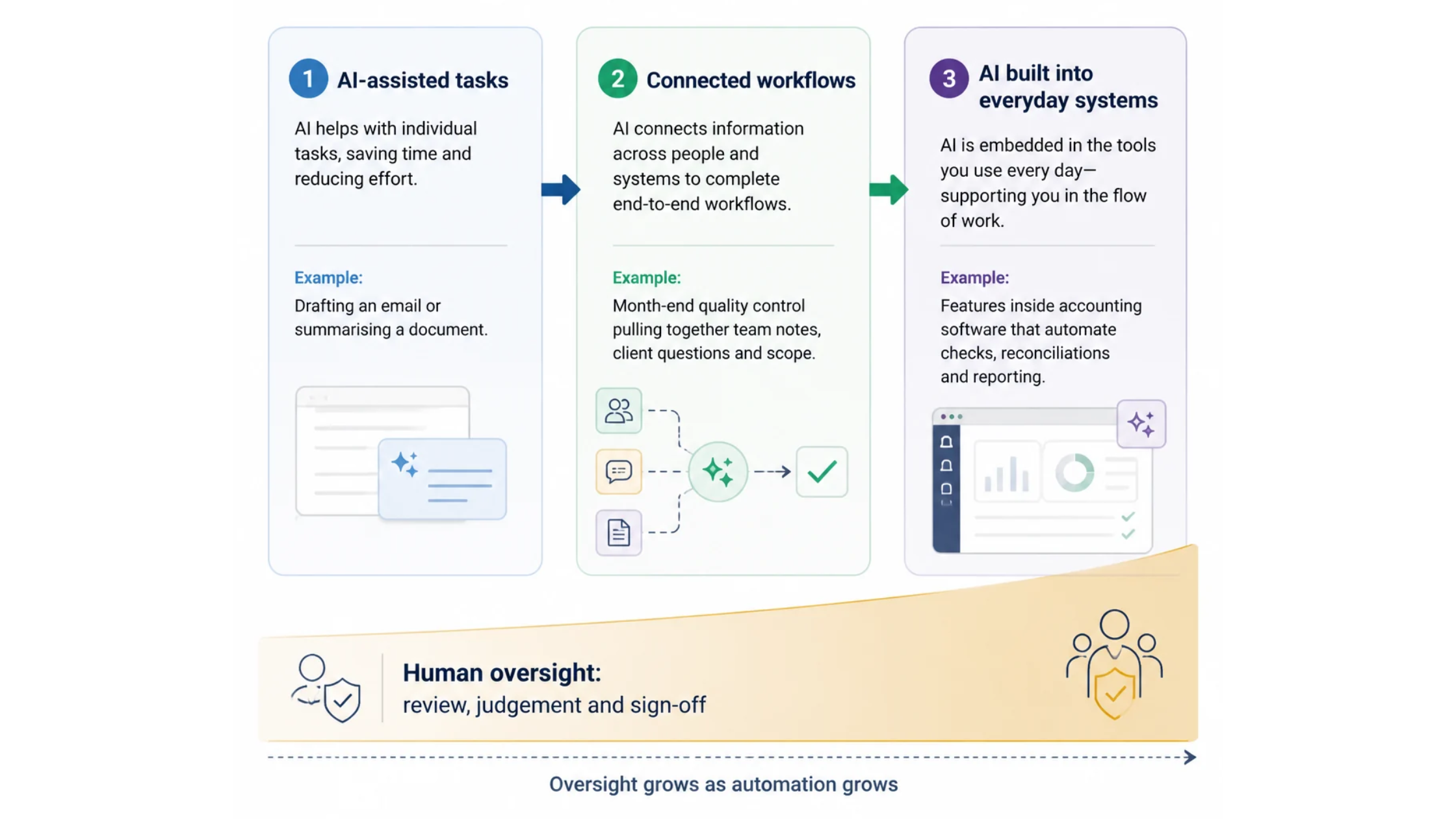
From answering questions to connected workflows
When we talk about AI, it's easy to think of large language models like ChatGPT or Claude and the sorts of things we ask them to help with: drafting an email, helping us with our marketing, researching a topic, analysing some figures or extracting data into a spreadsheet. Those are all very useful.
But the technology is moving well beyond answering questions and producing information, and increasingly towards carrying out a series of connected tasks.
One bookkeeper I spoke with recently has been developing an AI-assisted month-end quality control process. Rather than manually gathering information from several different places, she's testing a workflow that reviews notes from her team, checks outstanding client questions, identifies work that falls outside the agreed scope and suggests opportunities for automation. The system then flags what needs attention before the month-end work is signed off.
She's still developing and testing it, and it's taken a considerable investment of time to get to this point, so it isn't yet a proven system. But think about the implications. We're no longer talking about asking AI to draft a checklist for the month-end process. We're talking about AI potentially becoming part of the process itself.
Critically, that doesn't mean the work no longer needs oversight. Understanding how these workflows operate, and checking that they're producing the right results, becomes even more important.
Much of this technology will also be built into the accounting and business systems we already use, so bookkeepers won't necessarily need to become AI developers to benefit from it. They will, however, need to understand what their systems are capable of doing and how to use them responsibly.
Automation is only useful when it's doing the right thing
Another bookkeeper shared an experience that shows why good systems and sound bookkeeping knowledge still matter.
She had one client whose accounts were in excellent shape. Transactions had been coded consistently, the processes were well established and the financial information was reliable. For that client, Xero's auto-reconciliation worked beautifully.
But she'd also experienced the opposite: a file where the AI made suggestions based on historical precedents, which the client merrily clicked OK on. The trouble was, the historical precedents were wrong. Instead of saving the client time, it created a substantial clean-up exercise.
That's an important lesson to take forward. Automating a poor process doesn't necessarily improve it, and sometimes it allows mistakes to be made faster.
This is, of course, a great example of where a bookkeeper's knowledge and judgement become so important. You need to understand basic accounting for a start, what the downstream impact of your coding is, what the system is doing in the background, what information it's working with, whether the results actually make sense, and when human intervention is needed.
I've heard a lot of bookkeepers talk about how they’ve switched off auto-reconciling because they don't trust it, and sometimes that might be the right decision for a particular client or process. They’ve often made that decision after experiencing a frustrating AI clean-up. After all, there’s a solid argument that AI on its own shouldn’t always be trusted.
But they might also have come to that decision because they don’t know enough about how it works to trust it. Avoiding automation altogether isn't a particularly sensible long-term strategy.
We need to understand the technology well enough to decide where it adds value, where it creates risk and what controls should be in place. That requires bookkeeping knowledge, systems knowledge, an understanding of how AI works and how to “train” it, and an understanding of the client's business.
Using AI to get better at the work itself
Some of the most useful applications I've come across have nothing to do with processing transactions or preparing reports.
One bookkeeper was using AI to review transcripts of her client conversations and give her feedback on how she'd communicated. Had she asked the right questions? Had she talked too much? Had she missed something important the client was trying to tell her?
I thought that was a clever use of the technology, nothing to do with automating bookkeeping tasks at all. She was using AI to help her become better at working with her clients, which is a skill I think will matter more and more as the processing work reduces.
Meeting transcripts can contain a lot of sensitive client information, though, so a use like this also raises privacy and confidentiality questions which I'll come back to shortly.
We can use AI in a similar way to research unfamiliar topics, prepare for meetings, develop procedures, analyse information and challenge our own thinking.
We can ask it to review something we've written, identify gaps in a process or suggest alternative ways to approach a problem.
It can be an incredibly useful thinking partner, but we still need to bring our own knowledge and judgement to the conversation. The more we understand the subject, the better we can evaluate what AI gives us, and the more we understand our clients, the more useful we can make that information.
How clients are responding
Bookkeepers aren't the only ones experimenting. Clients aren't waiting for their bookkeepers to introduce AI; they're trying it out themselves.
Some business owners are asking AI how to manage their bookkeeping. Others are using it to analyse their financial reports, question transactions or find ways to reduce the amount they're paying for bookkeeping services.
And some are taking the results back to their bookkeepers. This is one of the developments I've been most intrigued by, because it changes the dynamic of the client relationship in ways many of us haven't fully thought through yet.
When a client's AI spots something the bookkeeper missed
I've heard it said many times that AI can be very confidently wrong, which is one reason accounting professionals still need to be involved. But the flip side deserves our attention too.
That's a very different challenge. AI can be wrong, but so can we, and if a client starts trusting the information they're getting from AI more than the answers they're receiving from their bookkeeper, there's a much larger issue at stake within your business.
We need to be willing to investigate these questions properly, rather than assuming an AI-generated observation must be incorrect, and to own it when it isn't.
One bookkeeper recently told me about a client who'd been using AI to analyse a cashflow report. Something in the report didn't appear to make sense, so the client began asking questions.
When the bookkeeper investigated further, she discovered that an account hadn't been mapped correctly in the accounting software, and it was affecting the cashflow report. In this case, the client's use of AI had surfaced a genuine issue that the bookkeeper hadn’t yet picked up.
Of course, this is not to say that the bookkeeper wouldn’t have picked it up eventually, but the client picked it up first, with the help of AI.
I doubt this will be an isolated occurrence, where AI and the client pick up mistakes before the bookkeeper does. We’re going to have to learn how to navigate these conversations with the client and their expectations when they do.
The old adage that we’re only human and humans make mistakes takes on new meaning here.
The scope and fees question
The same situation introduced another issue. The client who was asking questions and requesting assistance based on their conversation with AI was actually going beyond the scope of the bookkeeping services they'd initially agreed to pay a fixed fee for.
In fact, it was clear the client didn't really understand what they were asking for at all. It was the AI that had told them to check specific things with their bookkeeper.
On the one hand, I was encouraged to hear that the AI wasn't trying to replace the bookkeeper in this situation. It was directing the query back to them. That’s the outcome that I would hope for.
But the result was that the bookkeeper spent time investigating those questions, responding to the client and managing the consequences.
Correcting our own mistakes is, of course, part of the job. But much of the investigating and explaining that AI-prompted questions generate also has value, regardless of whether the questions originate with the client or with an AI tool, and I suspect we'll see a lot more of it.
As clients become more comfortable using AI, they may ask more sophisticated questions about their financial information, whether or not they fully understand what they're asking for. That'sa great opportunity for bookkeepers to provide more analysis and support.
But it also means we need to be clear about the services we're providing, what's included in our fixed fees and when additional work is out of scope and should be charged for. And we need to be able to answer those questions with confidence.
In practice, that might mean reviewing your engagement letters so they explain how client questions are handled, whether they come from the client’s own curiosity, their accountant or an AI tool. You might include a reasonable level of everyday questions within your fixed fee, and set out that deeper investigations, analysis or advice will be quoted or charged separately.
Letting the client know before you start any out-of-scope work, rather than surprising them with an invoice afterwards, also keeps the relationship on a good footing.
Some clients will need less help
We also need to acknowledge that some clients may genuinely need less help as AI becomes more capable. I've spoken with bookkeepers who are already losing clients or having their fees questioned because business owners believe they can manage more of the work themselves.
For some small businesses with straightforward bookkeeping, that may well be true, and it would be unrealistic to pretend otherwise. But not every business is straightforward, and that's where the picture starts to change.
Where the opportunities and risks lie
Complexity is where knowledge matters most
A business that manages inventory, sells across multiple platforms, uses connected payment processors, and has debtors, creditors, payroll, margins that need reviewing, cashflow to manage and complex reporting requirements is a lot stickier than a one-person business requiring simple cash-coding.
More complex businesses have systems to connect, processes to maintain, exceptions to investigate and decisions to make.
I was talking with a bookkeeper recently about a client whose inventory figures in Shopify and QuickBooks weren't agreeing. There were several possible explanations, and the bookkeeper needed to understand how stock purchases, inventory movements and cost of goods sold were being recorded across both systems.
In another example, I was talking with a bookkeeper troubleshooting why a consignment store’s point-of-sale figures weren’t agreeing with QuickBooks. She needed an in-depth understanding of the processes at store level when stock came in and when it was sold, and the various ways that people were paying and how that showed up in each system.
These are good examples of why understanding not only accounting principles, but also the way that different systems interact, is so important.
AI may be able to help investigate discrepancies like these. It might identify patterns or suggest possible causes much faster than we could manually. But someone still needs to establish what has actually happened and make sure the financial records are correct, and for now, that calls for someone who understands both the accounting and the systems.
Being able to do it isn't the same as wanting to
There's another very important factor that often gets overlooked when we talk about the potential of AI replacing bookkeepers.
A business owner being able to do their own bookkeeping doesn't mean they should.
It doesn't mean it's the best use of their time, and it doesn't mean they have the knowledge or the inclination to do it well.
Many business owners don't want to spend their time managing their bookkeeping. They want it taken care of, they want confidence that it's right, and they want to understand what the numbers are telling them.
Although the nature of the services that clients want may change, there will continue to be opportunities for bookkeepers to support businesses.
If we're doing less processing, what are we doing instead?
Processing transactions, reconciling accounts and producing accurate financial reports:these things are the foundation of reliable financial information that a business owner needs to help them to make sound business decisions.
But what happens when technology can do much more of the work we currently do, or used to do?
One possibility is to serve more clients. This is absolutely a valid option.
A second possibility is to spend more time helping the clients we already have, and I think there's a lot of potential in this one.
As bookkeepers, we often have an in-depth view of a business's financial, operational and personnel situation. This places us particularly well to talk with clients and help them to understand more about what'sactually happening in their business.
That might mean:
Identifying that margins have changed and questioning why.
Understanding why the business is profitable but still short of cash.
Looking at what's happening with debtors and following up with them if need be.
Noticing when costs are increasing faster than revenue.
Asking what could be improved about the way the business operates.
Understanding the decisions the owner is facing.
AI can help identify trends, analyse reports and suggest questions to investigate, which is one of the reasons I think it can become such a valuable tool for bookkeepers. But there's still a difference between identifying a movement in the numbers and understanding what it means for that particular business.
A bookkeeper who's worked closely with a client may know that they've recently employed another staff member, changed suppliers, expanded into a new market or been through a difficult trading period.
They understand the people, the processes and the circumstances behind the numbers, and they can have a conversation with the business owner about what to do next.
That's incredibly valuable work!
I also think we need to be realistic about the fact that AI will become increasingly capable of providing analysis and recommendations too. We shouldn't build our future around the assumption that AI will never be able to do those things.
Instead, we need to keep developing the skills and relationships that allow us to use the technology well and provide services that clients are willing to pay for.
The opportunity isn't limited to advisory
Whenever we talk about the future of bookkeeping, the conversation often turns to advisory services, and I absolutely see opportunities there.
But I don't think every bookkeeper wants to become a business adviser or financial strategist, and quite frankly, I don't think that's necessarily what every client wants either.
Some bookkeepers love working with systems. They're particularly good at identifying inefficiencies, improving workflows, connecting applications and helping businesses use technology properly. Others enjoy training clients, managing financial processes, supporting business owners or leading a team that delivers reliable bookkeeping services.
There's plenty of room for different strengths, and systems implementation, process improvement, client education and financial management are all valuable services in their own right.
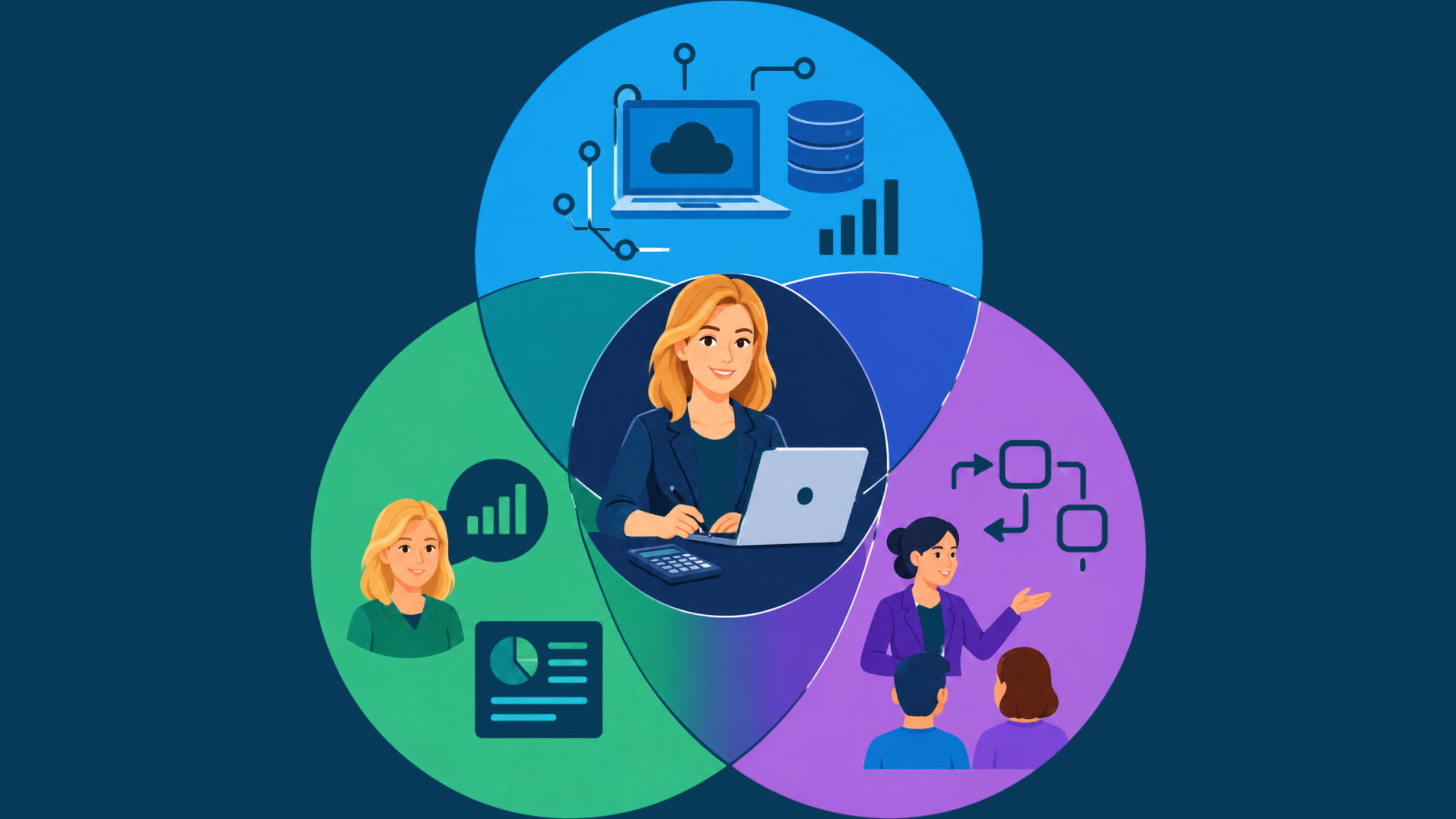
One of the ideas that came up in a coaching conversation recently was the growing importance of working at the intersection of technology, people and numbers.
A business doesn't necessarily need someone who can manually enter hundreds of transactions. It needs systems that capture the right information, processes that work, financial records it can trust, and people who understand what the information means.
Bookkeepers are well placed to help with all of those things, and when you consider how many small businesses still don't have good financial systems or reliable information, there's an enormous amount of work to be done.
Using AI well also brings new responsibilities. There are two I don't think we can afford to overlook in our own businesses, and a wider question that's attracting a lot of attention.
The first risk: privacy, confidentiality and data security
As bookkeepers start using AI more extensively, we need to think carefully about what information we're sharing with these tools and how we're using the results.
Recently, a bookkeeper was explaining how she'd been setting up AI projects for individual clients, bringing together information about their businesses, their bookkeeping processes and the work her team was doing. It was a fascinating example of what's becoming possible, but it also raised some questions for me about privacy, confidentiality and data security.
When we put client information into an AI platform, we need to understand where that information goes, how it's stored, who can access it and whether it's being used to train models (best practice for the work we do is to ensure this setting is turned off if that’s an option).
And importantly, we need to ensure that we have permission from our clients to use their information in this way.
The same questions apply, perhaps even more so, when we connect AI tools to other applications that contain financial information.
The answers will depend on the tools, their settings, the agreements we have in place and the privacy and professional obligations that apply to our businesses, which differ between countries and professional bodies.
These aren't reasons to avoid AI, but they are reasons to make sure we understand the technology and make informed decisions about how we use it.
It may also be a good time to check that your engagement letters and privacy information reflect how you'reactually working with client data.
The second risk: reliability and supervision
We also need to think about the reliability of the information AI produces.
I heard it said recently that if AI was asked "What's 1 + 1?" it might say 2, it might say 11, or it might say "window."
The point is that context matters and AI doesn’t always have that.
AI can be incredibly convincing, even when it's wrong. It can misunderstand a question, make assumptions, overlook important information or produce an answer that sounds perfectly reasonable but isn't correct.
That means we need appropriate checks and controls, particularly when we're dealing with financial information.
Those controls become even more important as we begin using AI to perform more complex workflows. It's one thing to check an AI-generated email before sending it. It's quite another to rely on an automated process that's reviewing financial records, making decisions or interacting with client systems.
The more responsibility we give the technology, the more carefully we need to consider how we're supervising it, because the professional responsibility for the work stays with us. If something goes wrong, our clients will still be looking to us, not the software.
Data centres, energy and the environment
There's one more part of the AI conversation that I'd be remiss to leave out, and that's its environmental impact.
Every request we make of an AI tool is processed in a data centre somewhere, and those data centres use a lot of electricity, and often a lot of water for cooling. As AI use has grown, so have concerns about what that means for emissions, energy supply and the communities that host these facilities.
Those concerns deserve to be taken seriously.
At a global level, the numbers are significant. The International Energy Agency1 estimates that data centres used around 415 terawatt-hours of electricity in 2024, roughly 1.5% of the world's total, and projects that this will more than double to around 945 terawatt-hours by 2030, with AI the main driver of that growth. Projections like these come with a lot of uncertainty, but the direction of travel is clear.
The technology companies’ own reporting shows the same pressure. Microsoft, for example, reported that its total emissions rose by 25% in its 2025 financial year, which it attributed mainly to expanding its data centres and to a change in how it accounts for renewable energy.2
The impact is increasingly being felt locally, too, wherever these facilities are built.
In Virginia, USA, which reportedly has one of the largest concentrations of data centres anywhere, a state review found that unconstrained data centre growth could nearly triple the state’s electricity demand by 2040.3In Alberta, Canada, connection requests from data centres have exceeded the province’s entire peak demand, prompting the grid operator to cap new connections for now.4
In Australia, the Australian Energy Market Operator expectsdata centres’ share of electricity on the main grid to grow from around 3% today to about 13% by the mid-2030s.5And here in New Zealand, an approved AI data centre in Southland has understandably prompted community questions about its power use, water, noise and consultation, although the developer says the region’s cool climate means it can rely on outside air rather than water for cooling.6
It’s entirely reasonable for local communities to ask who benefits, and who carries the cost.
When you look at a single question, though, the picture can look quite different. Google has estimated7 that a typical text prompt to its Gemini assistant uses about as much energy as watching television for less than nine seconds, and that the energy used per prompt fell 33-fold in a year.
However, those figures haven’t been independently verified, and they relate only to text prompts, not to generating images or video, or to the kind of connected, multi-step workflows I described earlier.
So the evidence is still developing. The technology is becoming more efficient all the time, and I’m hopeful that will continue, but demand is growing even faster, so it’s too early to say whether the overall impact will improve.
What does this mean for bookkeepers? I don't think the answer is to avoid AI altogether, any more than we've stopped using cloud accounting software, video calls or email, all of which also rely on data centres by the way.
But I do think it's reasonable to use it with some intention. That might mean choosing the right tool for the task, thinking a question through properly before asking it rather than regenerating the same answer over and over, and asking whether a task needs AI at all. Being aware of the trade-offs and making considered choices seems a sensible way to proceed.
This is also a subject some of our clients, and many of us, care about deeply, so it helps to be able to talk about it in an informed way.
What this means for running a bookkeeping business
All of this has implications that go beyond the work itself. It affects how we think about pricing, how we develop the next generation of bookkeepers, and the skills we need as business owners.
Pricing in a more efficient industry
If AI allows us to complete work much faster, should our fees go down? It's tempting to respond by saying that we're charging for value rather than time, so our prices shouldn't change. But I think the conversation is more complicated than that.
Your knowledge, experience, judgement and responsibility all have value, regardless of whether you charge hourly, fixed fees or through another pricing model, and there's no single model that's right for everyone. Becoming more efficient can also improve your profitability and create additional capacity.
What makes AI different is that it has the potential to make an entire industry more efficient, rather than one experienced bookkeeper becoming faster.
As that happens, competitors' costs may change, client expectations may change, and the market price for certain services may change too. Some bookkeepers may pass efficiency gains on through lower fees. Others may provide more value for the same price, and others may find a combination of the two works best.
I've explored this in much more detail in my article, AI and Bookkeeping Pricing: Should Your Fees Go Down?, including market rates, effective hourly rates, competition and how both bookkeepers and clients can benefit from greater efficiency.
How will new bookkeepers learn the fundamentals?
There's one question I keep coming back to in conversations about AI, and I don't think our industry has a good answer to it yet.
If AI takes over much of the routine processing work, how will new bookkeepers (and accountants) build their skills?
Most of us learned bookkeeping by doing it. Coding transactions, reconciling accounts, chasing down discrepancies and fixing our own mistakes taught us how the accounts fit together, often far more effectively than any course could.
That foundation becomes even more important as more of the work is automated. Think back to the auto-reconciliation example. The bookkeeper could see that the automation was perpetuating historical errors because she knew what correct coding looked like. The same applies to the cashflow report, the inventory discrepancy and every piece of AI-generated analysis we're asked to rely on.
You can't recognise when automation is getting it wrong if you've never learned what right looks like, and that kind of understanding is hard to develop by only reviewing work a system has already completed.
For bookkeeping business owners who employ, or plan to employ, a team, this means training can't be left to chance. When there was plenty of routine work, new team members built their skills through volume and repetition, with someone more experienced checking their work along the way.
If much of that work disappears, we'll need to design that learning on purpose. That might mean deliberately giving newer team members work that could otherwise be automated, involving them in clean-ups and investigations, asking them to explain why an AI-generated result is right or wrong rather than simply accepting it, and making time for the kind of review conversations that pass on judgment as well as process.
I'm also concerned about what this means for the industry as a whole. If firms stop creating entry-level roles because AI can handle the work those roles used to do, where will the experienced bookkeepers of the next ten years come from?
The judgment we keep saying is so valuable isn't something people are born with. It's developed over years of doing the work, making mistakes and learning from them, and I think we have a collective responsibility to make sure the next generation of bookkeepers still has the opportunity to develop it.
Technical expertise alone won't be enough
Strong technical foundations are essential, but there's another part of this conversation that's particularly important for bookkeeping business owners.
Being an excellent bookkeeper has never automatically guaranteed that you'll have a successful bookkeeping business, ifthat’s the route that you choose to go down. You also need to know how to attract clients, communicate your value, price your services, manage your time, build systems and run a profitable business. I think AI makes those business skills even more important.
If clients can access increasingly capable technology themselves, we need to be able to explain why working with us is worthwhile. That means being clear about the problems we solve, what we take responsibility for, what the client gains from having us involved, and how we make their business, and consequently their life, better.
Then we need to communicate that in a way they understand.
Being good at the technical work isn't enough if potential clients don't understand the value of what you provide. That's not a new problem, but I suspect AI will make it much harder to ignore.
What bookkeepers can practically do now
You don't need to become an AI expert
I can understand why some bookkeepers are feeling overwhelmed. There are so many tools, so much change happening at such a rapid pace, and so many people telling us what we should be using that it's difficult to know where to start, let alone keep up.
But I don't think you need to master every new application. You do need to develop enough understanding to make informed decisions about how AI might affect your work and your business.
Start with the tools you're already using and find out what AI capabilities are being introduced into your accounting software and other systems. Make an intentional decision about what you need to learn about these new features so that you can make the most of them, and put a professional development plan in place to do so.
It seems like everyone I talk to has already started experimenting with the likes of ChatGPT or Claude, but surveys suggest that a lot of people haven’t started on this journey yet. If this is you, try using it to help with something you already do. Perhaps that's preparing for a client meeting, brainstorming an internal process, drafting a proposal, or exploring the possible causes of an unusual movement in a report.
Use only information you're authorised to share and be mindful of confidentiality and data security. Check the results, learn what works and what doesn't, and gradually build your confidence. You don't need to do everything at once.
Six priorities for bookkeeping business owners
If I were to bring all of these conversations together, there are a few things I'd encourage bookkeeping business owners to focus on.
Understand where your business is most at risk. Look at the services you're currently providing. How much of your revenue comes from repetitive processing work that technology is increasingly able to automate? That doesn't mean you need to abandon those services, but it does mean you should understand how your business might be affected.
Get comfortable experimenting with AI. You don't need to become an expert overnight, but you do need to start learning. This is not flash-in-the-pan technology. It’s here to stay. It's much easier to make sensible decisions about technology when you'veactually used it.
Strengthen your technical and systems knowledge. Understanding accounting principles, financial processes and how different systems interact will help you recognise problems, evaluate AI-generated information and make better decisions about automation. If you employ a team, think about how they'll build that knowledge too, especially as there's less routine work for them to learn from.
Get closer to your clients' businesses. Understand how they operate, what they're trying to achieve, where they find things hard and what information they rely on. The better you understand their business, the more useful you can be.
Review your services, scope and pricing. Know what you're providing, what's included, what it costs you to deliver and what clients are prepared to pay. Think about how your services might need to evolve as the work changes.
Keep developing your business skills. Marketing, pricing, communication, leadership and client relationships are all part of building a strong bookkeeping business. Technology can help you with these things, but you still need to make the decisions.
And perhaps most importantly, stay curious.

Where does this leave us?
I don't know exactly what the bookkeeping industry will look like in five years, and I don't think anyone does. There will certainly be tasks that disappear, services that change and new opportunities that we haven't even considered yet. Some businesses will adapt quickly, while others will take longer. And some bookkeepers may decide that the kind of work they enjoy doing today isn't the work they want to be doing in the future. That's worth acknowledging too.
It’s not helpful to ignore AI, dismiss the risks or reassure ourselves that nothing significant will change. But neither do we need to panic and reinvent our businesses overnight. We've got an opportunity to learn, experiment, understand what our clients need and think carefully about where we can add the most value.
Good bookkeeping has always been about much more than processing transactions. It's about helping business owners have reliable financial information, understand their numbers and make better decisions.
The tools we use to do that will continue to change, and so will the way we deliver our services. I think the bookkeepers who are willing to keep learning, adapt their businesses and build on the value they provide will be in a much stronger position to navigate whatever comes next.
Stephanie