

AI and Bookkeeping Pricing: Should Your Fees Go Down?
If AI Makes Bookkeeping Faster, Should Your Fees Go Down?
I've been thinking a lot lately about what AI is going to mean for bookkeeping, and particularly what it could mean for bookkeeping pricing.
Not just how we do the work, but what happens to the value of that work and, ultimately, what we can charge for it.
If something that previously took you five hours can now be done in two because you're using AI and better technology, what happens to the price?
It's an interesting question, and I don't think the answer is as simple as saying, "I'm charging for value, not time, so nothing changes."
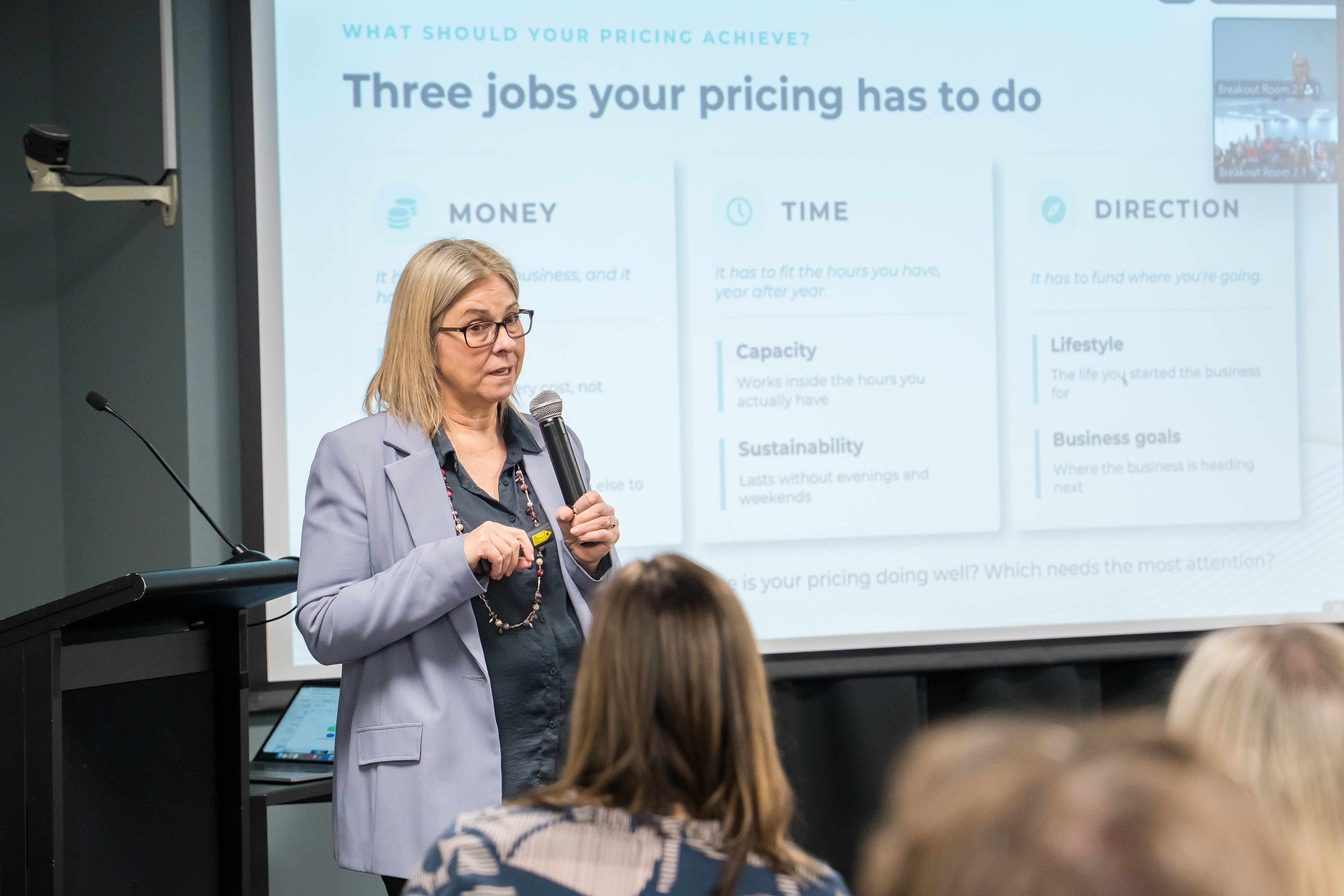
I've talked a lot about pricing recently, both at ICNZB's Bookkeepcon and in my Pricing for Profit masterclass, and my position hasn't changed: I don't believe there is one "right" way to price bookkeeping. Hourly pricing, fixed fees, value-based pricing and subscription pricing can all work. It depends on the type of work you're doing, the client you're doing it for and the business you're trying to build.
But AI introduces another dimension to that conversation.
Why shouldn't the client benefit too?
This actually reminds me of a conversation I had with my cousin Di many years ago, which I talked about in my Pricing for Profit masterclass.
We were discussing the idea that as you become more experienced and efficient, you shouldn't be penalised for getting the work done faster. Her response challenged my thinking: why shouldn't the client benefit from you becoming more efficient too?
It's a good question.
There's an argument that says I've invested years in developing my skills, improving my systems and learning how to do something in two hours that might take somebody else five, so why should I earn less as a result?
And there's absolutely validity in that.
But Di's point is valid too. Why should all of the benefit of increased efficiency belong to the service provider?
I've thought about that conversation many times over the years, but AI makes the question particularly relevant now.
Because this isn't only about one experienced bookkeeper becoming faster at their job. We're potentially looking at an entire industry becoming more efficient at the same time.
And I think that's an important distinction.
Your hourly rate should include the value of your expertise
There's another important part of this conversation, and that's the rate you're charging in the first place.
I often think about lawyers and accountants when I talk about this. A lawyer might charge $700 or $800 an hour. Their hourly rate reflects the years of knowledge and experience they're bringing to that hour, the complexity of the work, the responsibility they're taking on and the value of the outcome they're helping their client achieve.
Accountants are similar. Whether they're charging hourly or fixed fees, their expertise is built into what they charge.
I think bookkeepers sometimes assume that charging by the hour means we're simply selling our time, while the value of our expertise can only be reflected through fixed or value-based pricing.
I don't think that's true.
Your hourly rate can — and should — reflect the value of your expertise.
But that doesn't necessarily mean you should start with a low hourly rate because you're new or less confident and gradually increase it as you become more experienced.
I've often said that market rate is market rate. If the appropriate rate for the bookkeeping service you're providing is $100 an hour, feeling less experienced doesn't necessarily mean you should charge $50.
You might take longer to complete something because you're still learning. You might need to stop and look something up, or spend longer getting your head around a client's systems than a more experienced bookkeeper would. In that situation, I'd be more inclined to shave some of the time rather than discount the rate.
That's an important distinction.
When you first take on a client, you might feel new, unsure of yourself and conscious that some things are taking you longer than you'd like. Six months later, you've got everything shipshape. You know the client, you know their systems, you've solved the problems and you're completely on top of the work.
If you undervalued your rate at the beginning because you lacked confidence, you now have another problem: it's very difficult to suddenly tell an existing client that your hourly rate needs to double.
Set an appropriate rate in the first place, and you can use your judgement about how much of your learning time should fairly be passed on to the client.
There's also something interesting here when we bring AI into the equation. Under hourly pricing, if better technology allows you to complete the same work more quickly, the client already receives some of the benefit because you're billing them for fewer hours.
And if you're charging a fixed fee, I'd still want to know what effective hourly rate you're achieving from that work. You would not show that calculation to the client; it has nothing to do with how you present the price. But as the business owner, you need to know whether the work is profitable and whether you're being well compensated for the time and expertise you're putting into it.
That becomes particularly interesting as AI makes us more efficient.
Imagine a fixed-fee service that currently takes five hours to deliver. AI and automation reduce that to three hours, and perhaps eventually to two. Your cost of delivering that service has changed substantially.
Initially, that could be very good for your margins. If you're using technology more effectively than your competitors, you may be able to deliver the same work much more efficiently while the market price hasn't really changed.
But what happens when everyone gets faster?
This is where I think the AI conversation becomes different from simply becoming more experienced and efficient at your job.
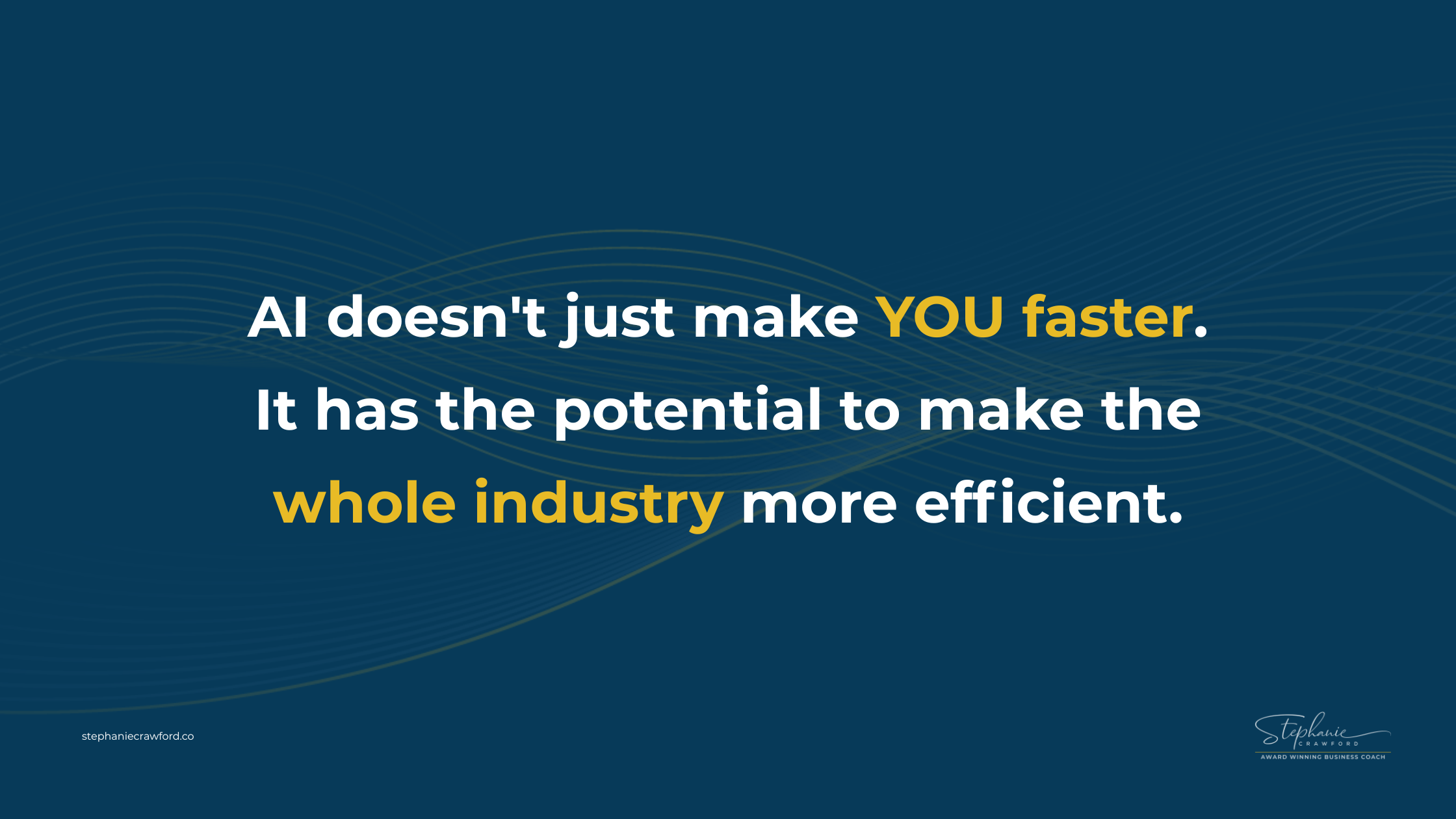
If you've spent years developing your skills and can complete a piece of work in two hours that takes a less experienced bookkeeper five, your experience has created that efficiency.
AI has the potential to create efficiency across the entire industry.
If the same technology is available to most bookkeeping businesses, your competitors' delivery costs are changing too. Some will keep their prices where they are. Some will reduce them. Some will use the extra capacity to provide more. And some will be prepared to work at a lower effective hourly rate than you are.
Over time, that's likely to influence what the market is prepared to pay for that particular service.
This is where something I've said for years about pricing becomes relevant: market rate is market rate.
You can't determine the market value of a service solely by deciding what effective hourly rate you'd like to achieve. But you absolutely need to know your effective hourly rate, because it tells you whether you can profitably provide that service at the price the market will bear.
And that's why I think AI could create an interesting period of adjustment for bookkeeping businesses.
Early adopters may initially capture more of the efficiency gain themselves through better margins and increased capacity. But as the technology becomes widely adopted, competitive pressure may mean more of that efficiency is ultimately passed through to clients.
Clients are also becoming increasingly aware of what AI can do. As AI becomes a normal part of the software they use themselves, I think we'll see more clients questioning what they're paying for if they know that significant parts of their bookkeeping are now automated.
There could even be some resentment if a client feels that the cost of providing their bookkeeping has fallen significantly but none of that benefit has been passed on to them.
That's not an argument against fixed fees or value-based pricing. It's simply recognising that pricing doesn't happen in a vacuum.
What clients are prepared to pay is influenced by the alternatives available to them, what competitors are charging and what they perceive the service to be worth.
Technology can change all three.
But there's another way we can respond to that increased efficiency.
What if we provide more instead?
I think this is where things become really interesting for bookkeepers.
Instead of reducing the fee, perhaps we use some of the time AI has freed up to provide more value for the same fee.
Perhaps the bookkeeping that previously consumed most of your monthly fee can now be completed much more efficiently. Instead of simply banking all of that saved time, you might use some of it to improve what the client receives.
Instead of sending the monthly reports, perhaps you review them and provide useful commentary. You might identify changes in margins, cash flow or debtors that the business owner should know about. You might have a more proactive conversation with them, improve one of their systems or help them understand something in their numbers that they hadn't noticed.
AI itself can help us provide some of that additional value efficiently. It can help analyse information, identify patterns, prepare commentary or suggest questions worth exploring. We then bring the accounting knowledge, context and judgement needed to work out what's actually relevant to that particular client.
Now we're having a different pricing conversation.
You're no longer charging the same fee for exactly the same service while keeping all of the efficiency gain for yourself. The service itself has become better, and the client is receiving some of the benefit too.
There may also be situations where the right decision is to reduce the fee. Perhaps technology means you can charge a client less, still achieve a healthy effective hourly rate and free up capacity to take on more clients.
That's not necessarily a bad outcome. In fact, it could be a very good one.
And there will be other situations where the additional value you're creating genuinely justifies maintaining or even increasing the fee.
So, should your fees go down?
Maybe.
I don't think AI suddenly gives us one new "correct" pricing model any more than we've ever had one before.
But I do think we need to be careful about assuming that because a client has always paid a particular amount, they always will.
If AI changes the cost of delivering the work, changes what competitors can offer and changes what clients expect from us, then it will inevitably have some impact on pricing.
At the same time, whatever pricing model you're using, your rate still needs to compensate you appropriately for your knowledge, experience, responsibility and the value you provide.
That's why I think we need to keep looking at both sides of the equation: what is a fair market price for the service we're providing, and does that price compensate us appropriately for our expertise and value?
Perhaps Di's question from all those years ago is even more relevant now: who should benefit when we become more efficient?
I don't think the answer has to be either us or the client.
In fact, depending on how we price and what we do with the time AI saves us, the client may benefit in several ways. They might pay less, receive more for the same fee, or simply have a better service. At the same time, we can still achieve a healthy effective hourly rate and build more capacity into our businesses.
Done well, there should be room for everyone to benefit.
Stephanie