
When “Just This Once” Becomes the Way You Run Your Business
When “Just This Once” Becomes the Way You Run Your Bookkeeping Business
There’s a phrase that can get you into quite a lot of trouble as a business owner: “Just this once.”
Like, “I’ll do the payroll late just this one time” because the client forgot to send the timesheet information through in time.
Or, “I’ll squeeze that meeting in just this once” even though it’s right in the middle of a block of focus time you’ve allocated for another client, or when you have a million other priorities that you really need to accomplish at that time.
Perhaps you’ll fix something “just this once” yourself because it’s quicker than going back to the team member.
Or you let a client pay late “just this once” without saying anything because they’re “usually pretty good.”
Maybe you answer a question or take on a task “just this once” even though it’s outside the scope of what the client is paying you for.
Individually, none of these things is particularly disastrous. Sometimes making an exception is absolutely the right thing to do.
We’re human beings working with other human beings, and we place a high value on the relationships we have with our clients. There are going to be times when a client needs some extra flexibility, or a team member needs a bit more support, or something genuinely unexpected happens.
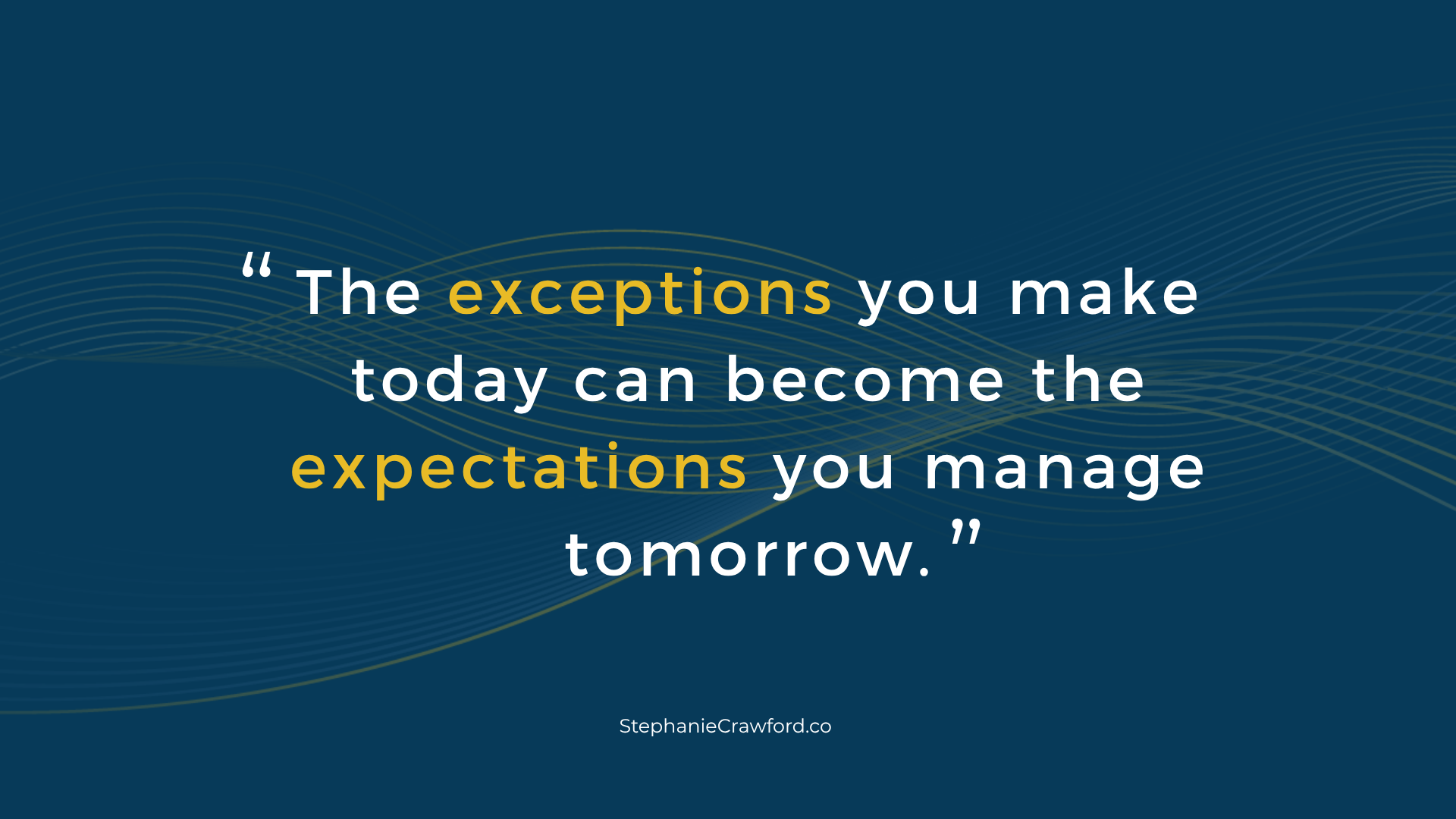
The problem is when those exceptions inadvertently become expectations.
When an exception starts becoming normal
You do something “just this once”, and then you do it just this once again. Before you know it, the client assumes it’s simply part of the service.
The client who sent their payroll information late and yet everything was processed on time anyway may start to assume that your deadline isn’t actually that strict.
The client who asked for something outside scope and received it without any conversation about an additional fee may assume that additional work like that is always included.
And if you regularly find a way to squeeze meetings into your diary whenever someone asks, people have no reason to know that those times don’t really work for you.
It happens with your team as well. A team member asks you how to do something and, because it will take you two minutes to fix it and ten minutes to explain it, you fix it yourself. It makes perfect sense at the time, particularly when you’re busy.
But if that keeps happening, your team learns that when they’re unsure about something, the quickest solution is to come to you. Then, six months later, you wonder why they’re not taking more ownership and why everything still seems to come back to you.
This is how some of the things that make running a business hard creep in. They’re not necessarily the result of one big decision. Often, they’re the accumulation of lots of very small ones.
The hidden cost of being accommodating
Bookkeepers are generally pretty good at looking after people. We’re a nurturing bunch, by and large, and it’s one of the things that makes us good at what we do.
You want to provide a great service. You don’t want to let a client down because they were late getting their information to you – especially with payroll when other people’s income is on the line.
You don’t want to make a fuss about a five-minute job that technically wasn’t included in their scope. And if a team member is struggling, of course you want to support them.
There’s nothing inherently wrong with any of that.
But there can be a difference between what makes life easier in the moment and what makes your business easier to run over the long term.
Fixing the team member’s mistake yourself might save you ten minutes today, but it doesn’t necessarily support them in handling the situation independently next time.
Doing that extra piece of work for a client without mentioning it might avoid an awkward conversation today, but if it happens every month for the next two years, the cost starts to look quite different.
And squeezing an appointment into a time you had set aside for something else might not matter once. But if your diary is now full of meetings at times you never really wanted to be available, perhaps it’s worth looking at how that happened.
Very often, nobody else has deliberately created the problem. We’ve simply allowed a pattern to develop.

We teach people how to work with us
It’s easy to get frustrated and think, “My clients have no boundaries.” But we have to take some responsibility for this too.
If you’ve always answered emails after hours, how would a client know that you don’t want to be answering emails at night? Even if you told them your boundary, your behaviour overrides what you’ve said.
If you always accept payroll information after your deadline, even reluctantly, why would they suddenly understand that your deadline matters?
And if you’ve been doing something outside scope for the last 12 months without charging for it, there’s a good chance your client genuinely believes that it’s part of the service they’re paying for. And that’s harder to come back from 12 months in than it is to just say something the first time.
In many cases, the client isn’t deliberately taking advantage of you. They’re just responding to the way the relationship has been established.
The same applies to your team. If every question gets answered immediately, there’s very little incentive for someone to spend 15 minutes investigating the answer themselves.
If you regularly take work back because it’s faster than explaining what needs to change, your team may never develop the confidence or skills to take full ownership of that work.
We teach people how to work with us by what we consistently allow.
That doesn’t mean becoming inflexible or difficult. It means getting clearer about what you want the normal way of working together to look like.
Being flexible is not the problem.
I certainly don’t want to suggest that every bookkeeping business needs a rigid set of rules that can never be broken.
One of the benefits of owning your own business is that you get to decide how you want to run it. You can absolutely make an exception for the client who is going through something difficult. You can take a meeting outside your usual hours because there’s a good reason to. You can do something extra for a long-standing client simply because you want to.
There will also be times when the sensible leadership decision is to jump in and help your team rather than turn something into a learning exercise.
The important distinction is whether you are consciously choosing to make an exception or whether you have fallen into a pattern that you no longer really want.
If you make an exception and feel perfectly happy about it, great. If you find yourself repeatedly doing something and feeling annoyed, resentful, overwhelmed or frustrated about it, that’s worth paying attention to.
What have you allowed to become normal?
One of the things I’ve learnt over the years is that the way you run your business is shaped by hundreds of very small decisions.
Of course, the big decisions matter. Your pricing matters. Your business model matters. Who you work with, who you employ, what services you provide and where you want the business to go all matter.
But your business is also shaped by what you say yes to, what you let slide, what you continue doing yourself, what you don’t charge for, when you make yourself available and what you allow to become normal.
The interesting thing is that you may never have consciously decided on some of those things at all.
You probably didn’t sit down and decide, “I want clients to be able to contact me at any time of the day or night.” You may simply have answered a few evening emails and gradually created that expectation.
You probably didn’t decide that you wanted to include unlimited extra work in your fixed-fee packages. You did a few extra things because they were quick and easy, and over time they became part of what the client expected.
And you probably didn’t hire a team because you wanted to continue making every decision yourself. But perhaps you kept stepping in and solving problems because, at the time, it seemed quicker and easier.
That’s why it can be useful now and again to stop and ask yourself:
What have I been treating as an exception that has quietly become part of the way I do business?
Where am I regularly doing something I don’tactually want to keep doing?
What am I allowing because dealing with it feels harder in the moment?
Have I inadvertently created an expectation that I now need to reset?
And, perhaps most importantly: Do I still want it to be this way?
You’re allowed to change the expectation.
One of the traps we can fall into is thinking that because we’ve always done something a particular way, we have to keep doing it.
You don’t.
You can tell a client that you’ve reviewed the way you manage payroll and, from next month, you’ll need their information by a particular time to guarantee that the payroll is processed on time. And if it’s not there by the deadline, then you won’t be able to do it in time.
You can have a conversation with a client about work that has gradually crept outside their original scope and explain that you need to review their package.
You can change the hours that people can book appointments with you.
And you can change the way your team brings questions to you. Instead of automatically giving them the answer, you might start asking what they’ve already checked, what they think the solution is and what they recommend doing next.
Some of those conversations might feel uncomfortable, particularly if you’ve allowed something to continue for quite a while. But that doesn’t mean you shouldn’t have them.
You’re not necessarily taking something away. You’re resetting the way you want to work together going forward.

Your business is being designed one decision at a time
When we talk about designing the business we want, it can sound like a very big strategic exercise involving business plans, goals, organisational charts and five-year visions.
And those things have their place.
But I think we also design our businesses through the small decisions we make every day. Every time you decide whether to squeeze in another meeting, whether to charge for additional work, whether to fix something yourself or coach someone else through it, and whether to uphold a boundary or let it slide, you’re making a decision about how your business operates.
Those decisions accumulate, and eventually they become “the way we do things around here.”
So perhaps just start noticing your own “just this once” moments this week.
Before automatically saying yes, ask yourself whether you’re genuinely happy to make an exception.
Because sometimes you absolutely will be.
But if you’re not, it might be worth dealing with it now rather than discovering six months from now that “just this once” has quietly become the way you run your business.

Does your bookkeeping business feel harder than it should?
If some of this has you thinking about other things that have gradually crept into your business, check out the replay of my masterclass Why Your Bookkeeping Business Feels Harder Than It Should.
We look at six different areas of a bookkeeping business where unnecessary friction can show up, and how to work out what actually deserves your attention first.