
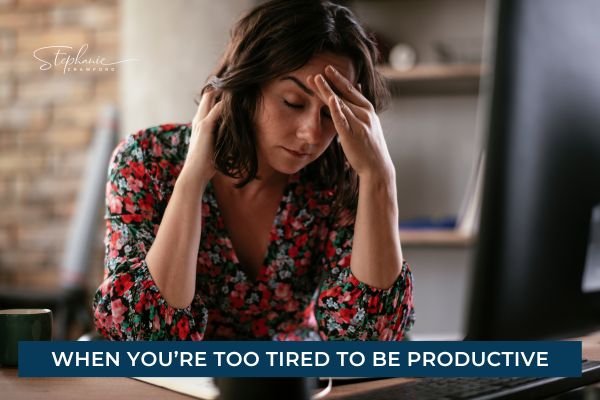
When You’re Too Tired to Be Productive
In the past few months, I’ve written about a lot of reasons why we procrastinate – fear, perfectionism, lack of clarity, low motivation, distraction, and overwhelm.
Another one that I see all the time in coaching conversations is low energy or emotional fatigue.
Just plain ol’ too tired – mentally and/or physically.
For us here in the Southern Hemisphere, we’re often coming back from our summer holidays, where we may have had 2 or 3 weeks off. So, it doesn’t seem to make a lot of sense to be tired when we’ve just had a break.
But sometimes we’ve come back before we’re actually fully rested.
You get through Xmas, and then your body takes a while to fully relax after the chaos of December. And it seems like you’re just finally easing into the whole rest and relaxation business when it’s time to start ramping things up again.
For bookkeepers in the Northern Hemisphere, you’ve had the chaos of Xmas, but then you don’t get much of a break after that, running right smack into January - AKA the busiest time of the year - and right at the start of winter no less.
Either way, it’s a lot. Even if you feel that you’re organised and on top of things, your nervous system still feels the load.
Sometimes procrastination is about energy (or a lack of it)
Something I often hear in coaching conversations is bookkeepers beating themselves up for perceived lack of action.
I say “perceived” because usually what happens when we look a little closer is anything but inaction! Usually, what I see is a whole lot of action amongst a whole lot of competing priorities, deadlines, and capacity issues.
The assumption is that you’re not “doing enough” (whatever “enough” is) and you have to simply try harder and work longer. But pushing yourself even harder when your energy is already running low rarely helps. In fact, it’s more likely to backfire.
Fatigue affects everything from your clarity, your focus, your patience, your decision-making, your emotional bandwidth, and even your sense of what’s possible.
When your energy is low, your brain starts quietly opting out of anything that feels like it’s a bit more effort.
You might find yourself pottering away at the easy things like emails, admin, and easy client reconciliations, but the harder stuff can feel like wading through mud. Or maybe you sit down to start something and your brain just stalls.
This kind of brain fog is an early warning sign that your nervous system doesn’t have the fuel it needs to support the level of thinking you’re asking from it.
A hard to-do? Or not enough energy?
In a recent coaching call, a bookkeeper I work with somewhat sheepishly admitted that an action item from her previous month’s list – to do with SOPs and delegation – hadn’t been accomplished.
She knew this would free up hours each month and ensure a high standard of work for her clients. She understood exactly what needed to be done, and she genuinely wanted to do it.
But whenever she tried to start it she felt a heaviness she couldn’t quite explain, like her brain couldn’t get traction.
We talked it through, and what came up was that while she had taken some time away from work, it wasn’t entirely restful. Instead, that time had been full and busy, rather than restorative. Her mind hadn’t had a chance to chill, and her body hadn’t had a chance to recharge.
So, when she came back to her desk, she was already running on empty. The energy just wasn’t there. It wasn’t a hard to-do necessarily, but it did require some headspace that she didn’t have the mental energy for.
Recognising that this was the case was the critical first step. Instead of forcing herself to push through, she took a couple of genuinely quiet days with no big expectations and no pressure. She allowed herself to rest, and that allowed her nervous system to catch up.
After that, she was able to easily do what she needed, wanted, to do.
Signs your energy might be low (even if you’re “getting stuff done”)
Fatigue changes the way work feels long before you recognise what’s happening to you.
You might not be falling asleep at your desk, but fatigue might still be showing up in quieter ways, such as:
Starting the day with great intentions but quickly losing momentum
Drifting between tasks without finishing anything
Decisions feeling harder or more complicated than they normally would
Finding yourself craving rest, snacks, or scrolling more often
Even simple tasks requiring more effort than usual
These are often signs that your energy needs tending to.
What can you do when the work’s piling up, but your energy is flagging?
If rest isn’t immediately available to you, here are a few shifts that can make a real difference to your wellbeing when your capacity is low:
1. Work with your natural rhythms
Everyone has their own energy patterns, and they’re affected by the season you’re in. Some people feel sharper in the morning; others find their focus arrives later in the day.
I coach about a concept called the Ideal Week, whereby you get to determine what your ideal work schedule would be. Noticing your personal energy peaks and troughs is the first place to start.
Instead of trying to force yourself into an ideal routine based on preconceptions and the “shoulds” of others, start noticing the time of day when your mind feels clearer, when your energy levels are highest, and schedule your more demanding tasks, where focus is critical, into that window.
2. Lighten the load
When your energy dips, long to-do lists are counterproductive. They don’t motivate. They’re overwhelming.
Instead, choose one priority for the day and 2 to 3 smaller ‘nice-to-haves’.
This will create more achievable expectations, a greater sense of accomplishment, and will give your brain space to function instead of shutting down under pressure.
3. Count your spoons
There’s a concept you might have heard of called ‘spoons’ and it can be a surprisingly helpful way to understand your own capacity.
The idea is that you start each day with a limited number of energetic ‘spoons’, and everything you do - from answering emails to making decisions to supporting clients - costs a spoon or two of energy. Some days you wake up with plenty of spoons, but other days you may only have a few.
When you begin seeing your energy this way, it becomes easier to plan your day around the reality of your capacity rather than the pressure of your expectations. And instead of pushing through, you start choosing where your spoons genuinely matter.
The magic is in recognising what kind of day you’re having and planning accordingly. It’s not about doing less overall. It’s about doing things at the right time, when your body and brain can actually handle them.
4. Rest before you hit the wall
Most of us tend to wait until we’re completely depleted before we allow ourselves a break, and by then it takes far longer to recover.
Short, intentional rests throughout the day – whether it’s a walk, a nourishing meal, or even a few minutes of quiet breathing – do more for your productivity than pushing through ever will.
Think of these as tiny investments that compound over time. They might feel a little indulgent in the moment, but they’re not. They’re a smart use of your time.

5. Be honest about your current capacity
Your capacity changes throughout the year, and that’s normal. Holiday recovery takes time. Busy seasons take energy. Winter takes a toll. Life takes a toll.
Energy isn’t static. It ebbs and flows with the seasons, your workload, health, and life.
Instead of expecting yourself to perform at the same level all year, ask what’s realistic for right now. Where could you lower the intensity without lowering your standards? What could you simplify, postpone, or delegate?
6. Let support in
This one’s big.
Sometimes the energy drain comes from trying to hold everything yourself, but none of us are meant to do everything alone.
Whether it’s delegating a task, asking for clarity, or help when using a system you haven’t used in a while, or simply admitting “I don’t have the energy for this today” - allowing support is a strength.
Getting help from others makes your business more sustainable, so reach out for help when you need it.
Fatigue isn’t a personal failing
I want to leave you with a reminder that you don’t have to push through every moment of low energy, and you certainly don’t need to feel guilty for being tired.
Fatigue is a signal that your body and mind have been working hard and need a little more care. Rest isn’t something you earn; it’s something you’re allowed to take because you’re human.
Your body and brain aren’t machines, so don’t treat them like
one.
When you stop treating your tiredness as a problem to fix and start seeing your energy as a resource to protect and nurture, everything about the way you work begins to feel more sustainable and more supportive of the business you’re building.
So ask yourself these two important questions:
Where has low energy been showing up for you lately?
What’s one small kindness you could offer your future self this week?
And by the way, you’re almost certainly doing better than you think. You’ve got this!
Stephanie Crawford